
NYS Prevailing Wage in 2026: What Broome County Owners Need to Know Before Bidding Public Works
On December 30, 2024, every contractor bidding public work in New York became subject to a mandatory state registry. Two construction seasons in, here's what's actually changed for school districts, library trustees, and municipal owners across Broome County.

On December 30, 2024, the rules changed for everyone who bids public work in New York. The state's Department of Labor opened a new Prevailing Wage Contractor Registry, and registration became mandatory. Two construction seasons in, the registry is no longer the new thing on the form. It is the form. Every school district, library board, town board, and authority that lets a covered project now starts the bid review by checking the registry. Contractors who skipped registration in 2024 are not bidding work in 2026.
For owners in Broome County, the practical effect is straightforward. The pool of contractors who are actually allowed to bid the prevailing-wage job has shrunk. The pool of contractors who can run certified payroll without errors has shrunk further still. And the cost of getting it wrong, on either side of the table, is no longer a warning letter.
What prevailing wage actually is
The prevailing wage is the hourly rate, set by law, that contractors must pay to workers performing covered public work in New York. It is set by the Department of Labor for each trade, county by county, and includes a cash wage plus a supplemental benefit rate. For a journeyman carpenter working in Broome County, the combined number is in the high forties per hour. It is a much higher rate than the state minimum wage, and it does not negotiate.
The rate exists because of Article 8 of New York State Labor Law, which requires that any contract for the construction, reconstruction, or repair of a public work pay the prevailing rate to all workers on the job. The law has been on the books since 1894. What changed in 2022 was the addition of Section 240-i, which requires the contractor itself to register with the state. What changed at the end of 2024 was the actual enforcement of that requirement.
The covered universe is broader than most owners realize. School district renovations are covered. Library projects are covered if the library is a public library and the funds are public. Town and village municipal buildings are covered. Certain private projects that receive public subsidies above defined thresholds are also covered, under the 2020 expansion that added the Public Subsidy Board. If a project is funded by ARPA dollars, IRA dollars, or the Downtown Revitalization Initiative, the prevailing-wage analysis is not optional.
What the registry changed
The Prevailing Wage Contractor Registry replaced an older, paper-driven process that asked contractors to register with the awarding agency on a job-by-job basis. The new system is statewide. A contractor registers once, every two years, and is then eligible to bid every covered job in every county. Subcontractors register too. The registration form requires disclosures: legal name, EIN, ownership, recent OSHA citations, recent wage-and-hour findings, debarments. The Department of Labor checks them.
The friction the registry created is real. Contractors who had been working public jobs for decades found themselves locked out for two months while they collected the documents and waited on review. Some never came back. The contractors who are on the registry today are, broadly, the ones who already had clean records and the office staff to handle the paperwork. The registry didn't make the bid pool smaller by accident. It made it smaller on purpose.
How it shows up on a job
On a covered project, three things happen that don't happen on private commercial work.
First, the wage rate schedule comes attached to the bid documents. Every trade that is going to be on the job has a number, journeyman, apprentice, helper, foreman, and the contractor is bidding labor at those numbers. The schedule updates twice a year, and the bid is required to honor whichever schedule is in effect when the work is performed.
Second, certified payroll runs every week. The contractor reports every worker's name, classification, hours, gross wages, deductions, and net for each day. The reports go to the awarding agency. They become public record. On the New York State Department of Labor's open data portal, anyone can pull a year's worth of certified payroll for any project and read every row. The transparency cuts both ways. It protects workers from being underpaid. It also protects honest contractors from being undercut on bid by someone who plans to misclassify a journeyman as an apprentice.
Third, an apprentice ratio applies. If you put a journeyman on the job, you are typically allowed one apprentice for that journeyman, no more. The ratio can stop a small contractor from staffing a job efficiently if the apprenticeship pipeline isn't there. It is one of the reasons the bigger public-works contractors run their own union-apprenticeship programs.
What it costs an owner
The number that gets quoted in the trade press is that prevailing-wage labor adds 15 to 30 percent to the labor portion of a project's cost. That range is real, but it is also not the whole picture for a school district or a library board.
What an owner is actually buying with prevailing wage is verifiability. The labor on the job is documented, week by week. The classifications are checkable. The benefits are paid through. The same level of documentation does not exist on private commercial work, where the labor cost is whatever the bid says it is and the contractor's books are the contractor's business. For an awarding agency that is spending public money, the verifiability is the point. The 15-to-30-percent line item is what verifiability costs.
There is also a softer cost: speed. A prevailing-wage job moves at the pace of the documentation. The certified-payroll cycle is weekly. A bid review that includes a registry check, a debarment check, an apprenticeship-program check, and a reference check takes longer than a typical private commercial review. School districts are used to that pace. Owners who are coming to public-works for the first time, usually because they are using a public-subsidy funding source, are not.
Who is actually active in Broome County
The state's open-data portal is a quiet way to read the local market. Pull the public-works register for Broome County, sort by site address, and the active contractors come into view by name.
On the Binghamton High School Locker Room renovation (PRC #2023004585), the certified-payroll filings show carpentry-trade work running over multiple weeks for the Binghamton City School District. The Town of Binghamton Community Center renovation, awarded by the Town Board on February 4, 2025, ran a competitive three-bid process, Tokos Contracting at $19,280, Thompson at $19,500, CW Construction at $19,950, with the contract going to Tokos at the low number, on a motion by Councilperson Donahue. The George F. Johnson Memorial Library Teen Room renovation in Endicott (PRC #2026000666) is a multi-trade scope: Carpentry, Drywall Applicator, and Painter, with twenty-three wage rows on the register and counting. The Johnson City Central School District has an emergency carpentry-trade project at the elementary/middle school complex on Columbia Drive (PRC #2025008550).
None of those project numbers came from a press release. They came from a single CSV download off the Department of Labor's open-data portal. Any school board member, any library trustee, any town councilor in Broome County can pull the same file and see who is actually working in their district right now.
For school districts and library boards
If you are sitting on the building committee for a Broome County school district or the trustees of a Southern Tier library, the practical pre-bid checklist is short.
Confirm that every contractor on the bidder list appears on the New York State Prevailing Wage Contractor Registry, and that their registration status is "Active." A registry lookup is free and takes a minute. Confirm that the contractor's recent OSHA history and wage-and-hour history are clean, the registry application disclosures are searchable, but a side-by-side check against the federal databases is worth the time. Confirm that the apprenticeship-program affiliations on file match the ratios the work will require. Pull a sample of the contractor's recent certified payroll filings on a comparable project and read them. They will tell you whether the contractor's office can run the documentation that your project will require, every week, for the duration of the work.
Ask the contractor for two references on prevailing-wage jobs they have closed out in the last three years. The references are not for craftsmanship. They are for how the contractor handled the certified payroll, the change orders, and the closeout. A great residential remodeler can be a poor public-works contractor if the office isn't built for the paperwork. The registry tells you a contractor is allowed to bid. References tell you whether they should.
What the registry doesn't do
The registry verifies eligibility. It does not verify quality. A contractor with a clean OSHA record and an active registration can still build a bad locker room. The registry is a floor, not a ceiling. The work of selecting a good contractor for a particular project, reading the punch lists from their last three jobs, walking a current site, talking to the owners, is the same work it has always been.
The registry also does not solve the apprentice-pipeline problem. Several of the most active Broome County trades, carpentry, drywall, sheet-metal, have apprentice ratios that small contractors find hard to staff. The registry doesn't change the math. A New York joint apprenticeship and training committee is still the most reliable way for a contractor to stay in compliance on a multi-month school job, and the contractors who have those affiliations are the ones who can take the larger scopes.
The trajectory
The direction of travel is clear. New York's public-works enforcement has tightened every legislative session since 2017. The Subsidy Board threshold dropped in 2020. The mandatory registry arrived in 2024. The Department of Labor's enforcement budget grew in 2025. Owners that bring public-subsidy funding into their projects are increasingly the ones who hold the prevailing-wage analysis closest, because the audit risk lives with them.
For a contractor based in Binghamton, the registry has been a net good. The pool of bidders is smaller. The work is steadier. The owners who are still in the public-works market in 2026 are the ones who care about the same things the contractor cares about: documentation, compliance, on-time closeout.
Frequently asked
How does a school district or library check whether a contractor is registered?
The Department of Labor maintains a public-facing registry lookup at dol.ny.gov. Search by legal name, EIN, or registration number. Active registrations show a current effective date and an expiration date roughly two years out. If the registration is missing or expired, the contractor cannot legally bid your covered project.
Does prevailing wage apply to a small library renovation paid for with private donations?
If the work is at a public library and the project is being administered by the library board on public-library property, the answer is almost always yes. The funding source is one factor; the public character of the owner is another. Talk to your library system's counsel, or call the New York State Department of Labor Bureau of Public Work directly. They will give you a written determination if you ask.
What is certified payroll, and who keeps it?
Certified payroll is a weekly report filed by the contractor on every covered project. It lists each worker's classification, hours, wage rate, fringe benefits, and net pay for each day worked. The report is signed under penalty of perjury and submitted to the awarding agency. The agency keeps it on file. Most reports also flow to the Department of Labor's open-data portal, where they become public record and can be searched by anyone.
Can an out-of-state contractor bid a Broome County school project?
Yes, if they register on the New York State Prevailing Wage Contractor Registry and meet the New York classification, apprenticeship, and benefit-fund requirements. The registry is the floor; the documentation requirements travel with the project. In practice, most school districts prefer contractors with a New York office and a New York joint-apprenticeship affiliation, because the paperwork is built for those structures.
What happens if a contractor underpays prevailing wage?
The contractor owes back wages, civil penalties on top of the back wages, and, for repeat or willful violations, debarment. A debarred contractor cannot bid public work in New York for five years. The Department of Labor publishes the debarment list. Awarding agencies that pay a debarred contractor can lose their own bidding rights. The penalties are designed to land on every party that benefited from the underpayment, not just on the contractor.
More from Tokos Contracting
Tokos Contracting is a New York State Department of Labor-registered prevailing-wage contractor based in Binghamton, NY. The active book includes Binghamton High School, the George F. Johnson Memorial Library Teen Room in Endicott, the Johnson City school district, and the Town of Binghamton Community Center, plus library work in Downsville and Ithaca. School boards and library trustees in Broome, Tioga, Tompkins, and Delaware Counties can request a bid directly, or browse the documented project record on the projects page.
Sources
- New York State Department of Labor, Public Work and Prevailing Wage. Accessed May 2026.
- New York State Department of Labor, Bureau of Public Work & Prevailing Wage Enforcement Laws and Guidance. Accessed May 2026.
- Government Contracts Legal Forum, "New Registration Requirement for Contractors and Subcontractors Performing Public Works and Covered Private Projects in New York," February 9, 2023.
- NYC District Council of Carpenters, "Prevailing Wage Contractor Registry," December 17, 2024.
- Pechman Law Group, "Ten Things to Know about Prevailing Wage Law in New York," May 11, 2021.
- New York State Open Data Portal, Public Works Project Database CSV. Accessed May 2026.
- Town of Binghamton Town Board, Work Session Minutes, February 4, 2025.
More from the blog
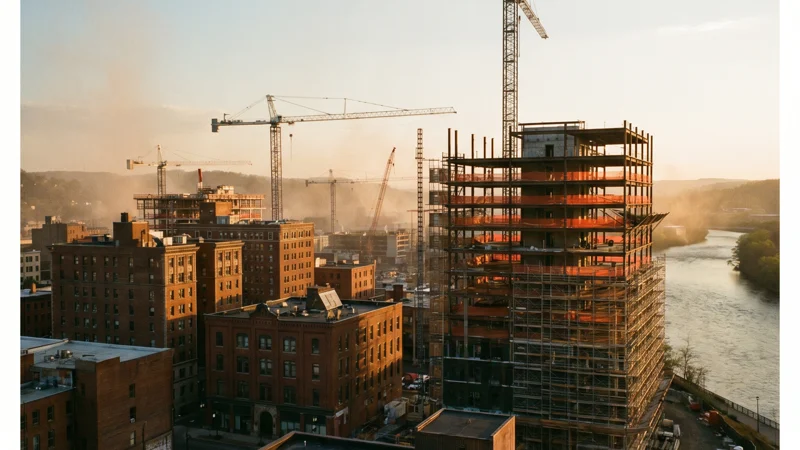
Broome County Construction News: May 2026
Binghamton University's $34M Decker School and $29M Bartle Library by Fahs Construction, UHS Wilson Medical Center by LeChase, BOCES Glenwood's $37.3M DASNY bond, the $5M Henry & Washington streetscape by Vacri, the Clinton Street DRI Round 8 open call, the Crowley Factory adaptive reuse, and the proposed Broome Technology Park, the major construction projects in Broome County, NY in May 2026.
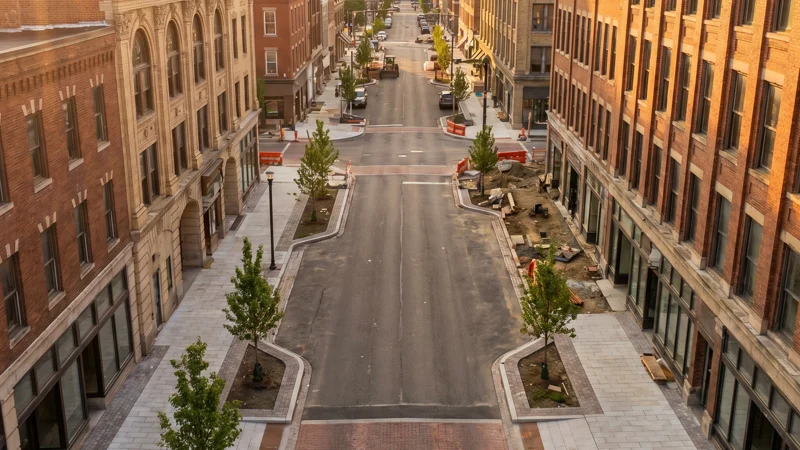
The $5M Henry & Washington Streetscape: What It Means for Downtown Binghamton Property Owners
Mayor Kraham announced the Henry and Washington Street streetscape in May 2025. Two construction seasons later, the work is underway and a block away from Tokos Contracting's Main & Front Street corridor. Here's what changes for the buildings inside the work zone.