
The $5M Henry & Washington Streetscape: What It Means for Downtown Binghamton Property Owners
Mayor Kraham announced the Henry and Washington Street streetscape in May 2025. Two construction seasons later, the work is underway and a block away from Tokos Contracting's Main & Front Street corridor. Here's what changes for the buildings inside the work zone.

Mayor Jared Kraham announced the second phase of Binghamton's downtown arts-district streetscape on a Tuesday in May 2025. The number was five million dollars. The contractor was Vacri Construction. The work was scheduled to start that week, run through the fall, and wrap with final paving and landscaping in spring 2026. A year later, the orange cones are still up on Henry and Washington, and the project is doing what city streetscapes are supposed to do: it's making downtown property along the work zone a different asset class than it was before construction started.
For property owners who hold buildings inside the corridor, the question isn't whether the streetscape is good for downtown. It plainly is. The question is what the streetscape changes about the building you own, what it lets you do, what it asks of you, and how the math on a tenant-improvement or façade scope shifts now that the public realm in front of your front door is being rebuilt.
What was actually funded
The five-million-dollar budget covers Henry Street, Water Street, and Washington Street, with the heaviest concentration of work near the Broome County Forum Theater. A million dollars of that came from the Greater Binghamton Fund, a placemaking and downtown-revitalization line item administered by Empire State Development. The remaining four million is a mix of city, county, and federal sources stitched together for what the city calls Phase 2 of its arts-district streetscape program.
The published scope of work reads like a list of every line item that drives Walk Score upward at once. New street lights. Pedestrian and traffic signals. Wider sidewalks built for outdoor dining. Safer pedestrian crossings, including a raised crosswalk on Washington Street to slow traffic ahead of performances at the Forum. Street trees and landscaping. Underground utility upgrades. New pavement on top of all of it.
The businesses inside the work zone, Lost Dog Cafe, Garage Taco Bar, The Shop, Renaissance Tattoo, Old Barn Market, Crowbar Arcade, stayed open through construction. Driveway and business-entrance access stayed maintained. Washington Street ran on a one-lane closure for extended periods. Henry got hit harder; full closures came and went on a schedule that the city published in advance and that crews mostly held to.
What this changes for the building you own
A streetscape isn't a building permit. It's not telling you what to do with your property. But it is reshaping what your property is worth and what tenants will pay for it, and that pulls a string on every other decision an owner has to make.
Consider a building on Washington with a vacant ground floor. Before the streetscape, that ground floor was a tough lease: narrow sidewalk, fast traffic, a streetlight three poles away from your front door, no obvious through-line to the Forum's foot traffic on a show night. The same ground floor after the streetscape is a different asset. The sidewalk is wide enough for tables. The crosswalk slows the traffic. The street trees soften the elevation. The lighting reaches your transom. Every variable that a restaurant operator looks at when underwriting a lease just moved in your favor.
The economic shorthand for what's happening is straightforward. The city has just spent five million dollars on the public side of the property line. That spend is non-rivalrous, every owner inside the work zone benefits whether or not they participated in the planning. Owners who can move quickly to capture that benefit, by upgrading the private side of the property line in a way that pairs with the new public realm, are the ones who see the rent number and the appraisal number both move. Owners who wait two years end up bidding the same façade scope into a tighter labor market with less of the streetscape's visibility to point at in tenant negotiations.
The façade program pairing
The piece that gets quietly underused is the city's Commercial Façade Improvement Program, run by the Binghamton Local Development Corporation. The program reimburses property owners for up to 75 percent of the cost of façade and storefront work, signage, awnings, paint, windows, lighting, and explicitly extends to interior commercial buildouts and leasehold improvements as well. The cap, the application window, and the eligibility geography shift year to year, but the underlying mechanism doesn't. It's a public dollar that comes in to match the private dollar.
The streetscape doesn't change BLDC rules. What it changes is the math on whether to apply. If the public realm in front of your building is being rebuilt anyway, the marginal return on a paired façade upgrade goes up. A new awning over a sidewalk that was four feet wide, with a streetlight two doors down, is one thing. The same awning over an eight-foot sidewalk under new pedestrian lighting, two doors from a raised crosswalk, is a different thing. The façade investment is the same dollar. The visible result is not.
The owners who stack a BLDC façade reimbursement on top of a streetscape-completion timeline tend to come out of the cycle with a building that leases at a number they couldn't get before. The ones who look at it as two unrelated processes tend to leave money on the table.
What the construction window asks of you
If you own a building inside the Henry/Washington/Water corridor, there are three questions worth working through with your contractor before the cones come down.
The first is access. Material deliveries during the active construction phase are constrained, sidewalk closures, lane closures, and the contractor's staging areas all compress the window when you can stage your own work. Most façade scopes need a sidewalk shed, a dumpster zone, or both. Pulling those permits in coordination with the city's streetscape contractor is the difference between a six-week scope and a sixteen-week scope. Vacri's superintendent on Henry is reasonable about scheduling, but they have their own pull dates to hit.
The second is utilities. Phase 2 includes underground utility upgrades, water, sewer, electric, communications. If your building has a service line that's older than the streetscape, this is the one window where coordinating a service replacement with the city's open trench is essentially free. Two years from now, a new service line means cutting the new pavement, restoring it to spec, and absorbing the cost of both. Right now, it means coordinating a tap with the contractor who's already in the trench.
The third is sequencing. A façade or interior renovation that's tied to the streetscape's reopening, an "open the doors when the sidewalks reopen" timeline, needs to start design now and bid in the late summer. The labor market in Broome County is small enough that a fall mobilization for a winter scope is realistic, but it requires the architect, the contractor, and the BLDC application to be moving in parallel rather than serially. Owners who try to start design in the spring of 2026 to capture the streetscape's spring reopening will find that every other owner in the corridor had the same idea.
The arts-district strategy, briefly
It's worth naming what the streetscape is part of. Binghamton's arts-district investment isn't a one-off. The city is in Round 8 of the New York Downtown Revitalization Initiative, with a separate ten-million-dollar award for the Clinton Street corridor announced more recently. The Forum Theater anchor, the streetscape program, the BLDC façade reimbursement, and the DRI sit on top of a National Register Historic District designation that has been on the city for decades. None of those programs are individually transformative. Stacked, they are the slow apparatus by which a downtown rebuilds.
The owners who do well in this kind of cycle are the ones who treat the public-investment timeline as the structural frame for their own building's repositioning. The streetscape sets the dates. The DRI sets the corridor priorities. The façade program sets the dollar match. The historic district sets the design vocabulary. A property owner who reads all four together is making different decisions than one who's only thinking about whether to repaint the trim.
Frequently asked
How do I confirm whether my building is inside the Phase 2 work zone?
The city's Department of Public Works publishes the active work zone with block-by-block detail at binghamton-ny.gov as construction advisories. The Phase 2 zone runs along Henry, Water, and Washington with the heaviest concentration near the Forum Theater. If your building's frontage falls on one of those streets, you're inside.
Can I apply for the BLDC façade reimbursement during active streetscape construction?
Yes. The Binghamton Local Development Corporation administers the Commercial Façade Improvement Program on a rolling basis, with eligibility geography that includes the streetscape corridor. Application timing should be coordinated with your contractor and architect; the reimbursement structure typically requires the work to be approved before it's started.
Will the streetscape's wider sidewalks change my outdoor-dining permitting?
The wider sidewalks are designed to accommodate outdoor dining as part of the public-realm intent of the project. Outdoor-dining permits still go through the city's licensing process and are issued seasonally. The wider sidewalk doesn't grant the permit, but it removes the most common reason permits get denied on narrow downtown blocks: insufficient pedestrian clearance.
What happens to my building's water and sewer service during the underground-utility phase?
The contractor coordinates short service interruptions with each affected building in advance. If your service line is older, pre-1960 in most of the corridor, the open trench is the one window where a paired private-side service replacement is dramatically cheaper than the standalone alternative. Talk to your contractor and to Public Works before the trench is closed.
Is the streetscape going to be permanent, or is this a phased plan with more to come?
The Phase 2 work is permanent. The city's broader DRI strategy includes additional corridors, most notably Clinton Street, awarded ten million dollars in the latest DRI round, that will see comparable work in subsequent construction seasons. The arts-district streetscape itself, once landscaped in spring 2026, is the finished version.
More from Tokos Contracting
Tokos Contracting works the Main and Front Street corridor a few blocks from the Phase 2 zone, with documented projects at 11 Main (Peterson's Tavern), 4 Main (riverfront restaurant remodel), 8 Main (façade restoration), and the Walter's Shoe Store adaptive reuse at the corner of Main and Front. Commercial general contracting, historic restoration, and new construction are the primary service lines for downtown property owners. Request an estimate or browse the documented project record on the projects page.
Sources
- City of Binghamton, "Mayor Kraham Announces Streetscape Improvements," May 20, 2025.
- City of Binghamton, "Binghamton Awarded $10 Million for Clinton Street Revitalization."
- City of Binghamton, "Binghamton Local Development Corporation (BLDC)."
- City of Binghamton, "Historic Preservation."
- Empire State Development, "Greater Binghamton Fund."
More from the blog
Broome County Construction News: May 2026
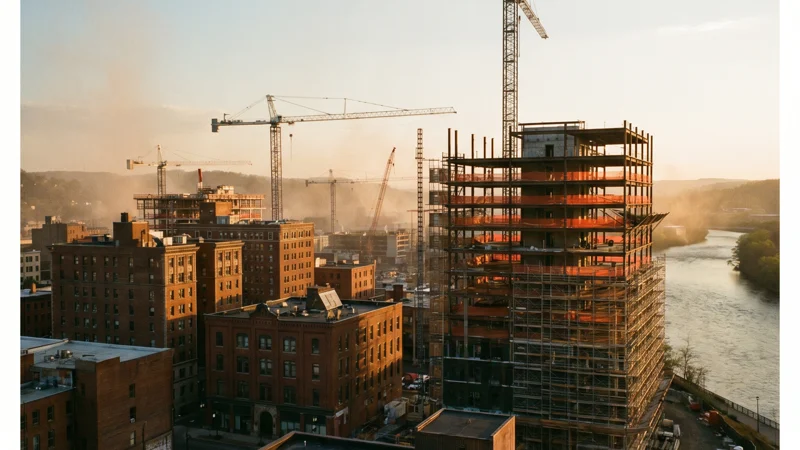
Binghamton University's $34M Decker School and $29M Bartle Library by Fahs Construction, UHS Wilson Medical Center by LeChase, BOCES Glenwood's $37.3M DASNY bond, the $5M Henry & Washington streetscape by Vacri, the Clinton Street DRI Round 8 open call, the Crowley Factory adaptive reuse, and the proposed Broome Technology Park, the major construction projects in Broome County, NY in May 2026.
NYS Prevailing Wage in 2026: What Broome County Owners Need to Know Before Bidding Public Works
On December 30, 2024, every contractor bidding public work in New York became subject to a mandatory state registry. Two construction seasons in, here's what's actually changed for school districts, library trustees, and municipal owners across Broome County.