
Adaptive Reuse in Broome County: Reading the Crowley Factory and 71 Main Street Playbook
The Crowley Factory Lofts on Conklin Avenue and the 71 Main Street listing represent two ends of the same Broome County strategy: take a vacant landmark, hold the bones, change the use. Here's what the playbook actually looks like up close.

Two buildings, four miles apart, tell most of what an owner needs to know about adaptive reuse in Broome County right now.
One is the old Crowley dairy factory at 135 Conklin Avenue on Binghamton's Southside, a 73,000-square-foot brick mass that shuttered in 2017 and is now being rebuilt into market-rate apartments and ground-floor commercial space by Crowley Factory Lofts, LLC. The other is 71 Main Street, a 10,472-square-foot Colonial-style building near downtown that came on the market in early 2026 at $715,000, listed by SVN Innovative Commercial Advisors as a property "well suited for adaptive reuse." Different scales. Different starting points. Different exit pictures. Same playbook.
The playbook isn't proprietary. The state writes most of it. The city writes the rest. What separates a successful adaptive-reuse project in Broome County from a sunk-cost project sitting on a balance sheet for five years is whether the owner read both halves before they signed for the building.
Why Broome County favors adaptive reuse, structurally
Three things make adaptive reuse pencil in Broome County more often than it does in comparable upstate markets.
First, the building stock. Binghamton has four National Register Historic Districts, Court Street, State and Henry Street, Rail Terminal, plus the Clinton Street district added in the most recent DRI round, and three are also designated locally. The City's Commission on Architecture and Urban Design, established in 1964, gives the historic-fabric work a sixty-year procedural track record. Acquisition prices on these buildings are in the $50-to-$80-per-square-foot range, often less. A new build at the same address would land somewhere between $200 and $350 per square foot before tenant fit-out. The arithmetic on holding the bones is what makes the rest of the playbook viable.
Second, the funding stack. New York's Restore New York Communities Initiative has placed grant dollars on Broome County buildings consistently, Crowley Factory Lofts pulled a $2 million Restore New York award. The Greater Binghamton Fund placemaking line carries another tier of dollars for facade and storefront work. The Downtown Revitalization Initiative is up to Round 8. Federal Historic Tax Credits stack on top of all of it where the building qualifies. None of those programs are individually transformative. Stacked on a single project, they are the reason a small private syndicate can underwrite a 73,000-square-foot factory rebuild.
Third, the zoning is now permissive in ways it wasn't a decade ago. The 71 Main Street SVN listing names this directly: "recent zoning updates that allow for professional offices" inside what was previously a more restrictive use envelope. The City's planning department has spent the last several update cycles broadening allowed uses inside its historic and commercial districts, with a clear preference for the kinds of mixed-use programs that an adaptive reuse can produce. The zoning isn't the project. It's the precondition that lets the project be drawn.
Reading the Crowley Factory
Crowley is the high-end of the difficulty curve. A 73,000-square-foot factory built in the early 1900s, vacant since 2017, on a riverfront parcel along the Susquehanna. The building is masonry, load-bearing brick over heavy timber, with steel-frame additions on the back and concrete floors that were poured for milk-tank loading. The structural condition was, by industrial standards, sound. The mechanical condition was end-of-life on every system that had been left running.
The development structure tells you what kind of project it actually is. Crowley Factory Lofts, LLC, the project's special-purpose entity, secured a Sales and Use Tax Exemption Agreement with The Agency in 2023, plus PILOT benefits, payment-in-lieu-of-taxes, that flatten the property tax obligation during the construction period and the lease-up period. They stacked the $2 million Restore New York grant on top of that. Mayor Kraham called it "the type of dynamic rehabilitation project this historic property deserves," which is the language a city uses when it has aligned its incentives behind a deal.
The trades on a Crowley-class project are not the trades on a normal commercial renovation. Selective demolition is the long-pole, pulling out the dairy equipment, the production-floor finishes, and the non-original interior partitions without compromising the structure has to happen before any other scope can mobilize. Brick repointing on a building that size is a multi-month dedicated mason crew. Window replacement in a National-Register-eligible building is a specification problem before it's a procurement problem; storefront-style aluminum is usually rejected by the historic-preservation review and what comes through is a custom thermally-broken system in a profile that matches the original. Sprinklers, electrical service, plumbing risers, and HVAC are net-new installations through chases that have to be cut without disturbing the historic fabric. None of that work is routine, and none of it gets bid by every general contractor in the county.
The Agency's article on the project named the headwinds plainly: "rising costs, changing market conditions, construction logistics may require revisiting aspects." That sentence is the reality of every adaptive-reuse project of that scale. The pro forma that closed in 2023 isn't the pro forma that will lease up in 2026. Adaptive-reuse projects survive that arithmetic to the extent that the team is willing to revise both the plan and the contractor relationship as the building reveals itself.
Reading 71 Main Street
71 Main is the smaller, more typical version of the same problem.
The listing on Brevitas describes a 10,472-square-foot Colonial-style office building near the Court Street Bridge, close to downtown, walkable to the Forum Theater corridor, asking $715,000. The marketing copy uses the phrase "well suited for adaptive reuse" because the seller knows that the highest-and-best-use buyer is no longer a single-tenant office user. The cost-per-square-foot at the asking price is $68. That is acquisition arithmetic that supports a number of different exit pictures.
The most likely outcomes are two. The first is professional-office reuse, divided suites for legal, accounting, design, or medical tenants, which the recent zoning updates explicitly support and which requires the lightest construction touch. ADA upgrades, an elevator if the building has more than two stories, finishes throughout, an HVAC zoning rebuild. Probably $80 to $130 per square foot of construction cost on top of the acquisition. The second is mixed-use conversion, ground-floor commercial with apartments above, which trips into the change-of-use code-compliance work and is meaningfully more expensive per square foot but produces an asset with a different income profile. $150 to $220 per square foot of construction cost on a typical conversion.
Either picture starts with the same site walk. A general contractor walks the property with the prospective buyer and the buyer's architect. The walk surfaces the things you cannot see from the listing photos: the floor framing, the foundation moisture, the existing electrical service, the roof condition, the structural conditions at the original additions, the asbestos and lead inventory, the existing means-of-egress count. A clean site walk on a building like 71 Main produces a cost range, not a cost. The owners who close on adaptive-reuse buildings without a contractor walk are the ones who write capital-call letters to their investors twelve months later.
The procedural stack, in the order it actually happens
Most adaptive-reuse projects in Broome County move through the same procedural sequence, regardless of scale. The order matters more than people new to the work expect.
The first phase is feasibility. Title, survey, environmental Phase I, structural walk-down, contractor's conceptual cost range, architect's test-fit. This phase costs five-figure dollars and saves seven-figure mistakes. It happens before the deal closes, ideally during a due-diligence period long enough to do it without rushing.
The second phase is design and entitlement. Schematic design, site-plan review with the city's planning department, historic-preservation review where applicable (the Commission on Architecture and Urban Design has a public meeting calendar; submissions get scheduled), code-compliance review, and a financing package. Zoning is decided here. The fundability of the project, Restore New York, Historic Tax Credits, BLDC façade reimbursement, conventional debt, is also decided here.
The third phase is construction documents and bid. Permit set, MEP coordination, bid to a small set of qualified contractors. The bid pool for adaptive reuse in Broome County is limited; most general contractors who do high-quality private commercial work don't take on selective-demolition-heavy adaptive reuse, and most contractors who take adaptive reuse don't have the prevailing-wage chops if the project pulls public funds. Identifying the right contractor pool is part of the bid strategy.
The fourth phase is construction itself. Selective demolition, structural repair, envelope, MEP rough-in, finishes, commissioning, certificate of occupancy. The schedule on a Crowley-scale project is twenty-four to thirty-six months. The schedule on a 71 Main-scale project is six to twelve months for office reuse and twelve to eighteen for mixed-use conversion. Both schedules assume the building reveals itself reasonably during selective demolition. Both schedules slip when it doesn't.
What this kind of work looks like, on the record
Tokos Contracting's documented adaptive-reuse and mixed-use renovation work in the Main Street corridor sits at the smaller end of this scale. The Walter's Shoe Store conversion at the corner of Main and Front Street took a long-vacant retail building and turned it into mixed-use ground-floor commercial with apartments above, the kind of program that 71 Main Street's listing language imagines. The 246 Main Street project in Johnson City was a Central Business District mixed-use adaptive reuse that Mike Tokos walked the Village Planning Board through in person in August 2021. The Peterson's Tavern vertical expansion at 11 Main, the riverfront restaurant remodel at 4 Main, and the façade restoration at 8 Main are all variants of the same procedural stack, different scopes, different programs, same set of decisions about historic fabric, structural condition, and code-compliance pathway.
None of those projects are Crowley. None of them required the same scale of incentive stack. What they share with Crowley is the order of the work: site walk first, feasibility second, design and entitlement third, bid fourth, construction last. Owners who follow that order tend to finish their projects. Owners who skip steps tend to discover, somewhere in month nine of selective demolition, why the steps existed.
Frequently asked
What's the realistic cost-per-square-foot range for adaptive reuse in Broome County right now?
Office reuse on a sound-bones historic building runs roughly $80 to $130 per square foot of construction cost on top of acquisition. Mixed-use conversion runs $150 to $220. Industrial-to-residential adaptive reuse, the Crowley class of project, runs $200 to $350 depending on selective-demolition complexity, structural repair, and the depth of MEP and envelope replacement. Site walks produce cost ranges; pro formas built without a site walk produce cost regrets.
Do I have to use the New York State Historic Tax Credit?
Not unless you want it. The state and federal Historic Tax Credit programs are stacked on income-producing rehabilitations of buildings that are listed on, or contributing to, the National Register. The credits are valuable, 20 percent federal, 20 percent state, both available on qualified rehabilitation expenditures. They also impose Secretary of the Interior's Standards on the design, which can constrain decisions about windows, finishes, and additions. Owners who don't need the credits sometimes prefer not to take them.
How long does the city's historic-preservation review take?
The Commission on Architecture and Urban Design meets on a regular published calendar. A submission that arrives complete and on time for a meeting cycle gets reviewed at the next meeting. Resubmissions, if requested, push the timeline by one full cycle. A reasonable assumption for an adaptive-reuse project that needs design review is two to three meeting cycles for full approval, six to twelve weeks calendar time.
Can a single general contractor handle both selective demolition and the new construction scope?
Yes, and on most Broome County adaptive-reuse projects, that's the right structure. A contractor who self-performs selective demolition keeps the schedule under one party's control, owns the discoveries that come out of demolition, and can sequence them into the design and procurement of the rebuild without a handoff. The exception is environmentally hazardous demolition, abated asbestos or lead, which goes to a licensed abatement specialist regardless of who runs the rest of the work.
What's the single most common mistake on adaptive-reuse projects in Broome County?
Underestimating selective demolition. The line item gets bid as a percentage of the total scope and almost always lands at a higher dollar value than the bid set aside for it. The owners who plan their financing with that line as a known unknown, who fund a contingency on it specifically, finish their projects on schedule. The owners who treat it as a fixed-price scope find themselves negotiating change orders on it through the rest of construction.
More from Tokos Contracting
Tokos Contracting works in commercial general contracting, historic restoration, and new construction across Broome County, with a documented adaptive-reuse and mixed-use track record on the Main and Front Street corridor in Binghamton and the Central Business District in Johnson City. Owners and developers evaluating an adaptive-reuse acquisition can request a site walk and a cost range, or browse the documented project record on the projects page.
Sources
- The Agency, "Reviving a Landmark: Crowley Factory Lofts Bring New Life to Binghamton's Southside," November 12, 2025.
- Brevitas, "71 Main Street, Binghamton, NY 13905," listing accessed January 2026.
- SVN Innovative Commercial Advisors listing announcement, January 2026.
- City of Binghamton, "Historic Preservation."
- City of Binghamton, "Binghamton Local Development Corporation (BLDC)."
- Empire State Development, "Restore New York Communities Initiative."
- Empire State Development, "Greater Binghamton Fund."
- Village of Johnson City Planning Board, Meeting Minutes, August 24, 2021 (246 Main Street review).
More from the blog
Broome County Construction News: May 2026
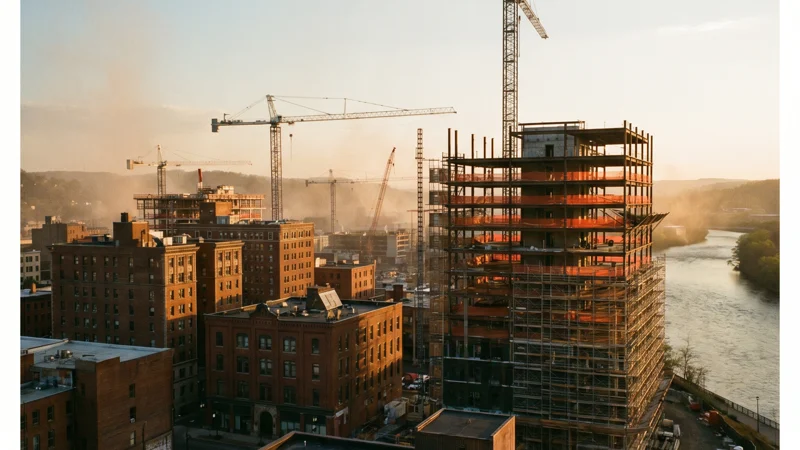
Binghamton University's $34M Decker School and $29M Bartle Library by Fahs Construction, UHS Wilson Medical Center by LeChase, BOCES Glenwood's $37.3M DASNY bond, the $5M Henry & Washington streetscape by Vacri, the Clinton Street DRI Round 8 open call, the Crowley Factory adaptive reuse, and the proposed Broome Technology Park, the major construction projects in Broome County, NY in May 2026.
NYS Prevailing Wage in 2026: What Broome County Owners Need to Know Before Bidding Public Works
On December 30, 2024, every contractor bidding public work in New York became subject to a mandatory state registry. Two construction seasons in, here's what's actually changed for school districts, library trustees, and municipal owners across Broome County.